uae-vatregistration.com

The Ultimate Guide: Documents Required for UAE VAT Registration – FTA Checklist (2026)
Documents required for UAE VAT registration explained. Get the complete FTA checklist for 2026 and register correctly without delays. Expert help available.
Gupta Group International
1/16/20265 min read


The Ultimate Guide: Documents Required for UAE VAT Registration – FTA Checklist (2026)
Introduction:
Value Added Tax (VAT) in the United Arab Emirates (UAE) is a key component of the country’s taxation framework, introduced on January 1, 2018 to diversify government revenue and bring the UAE in line with global tax practices. Since its introduction, VAT has impacted thousands of businesses operating in the UAE, requiring them to understand and comply with registration and reporting requirements set by the Federal Tax Authority (FTA).
One of the most critical phases for businesses entering the VAT regime is the VAT registration process – and at the heart of this process is the document checklist. Submitting complete and accurate documents is essential to avoid delays, rejections, or penalties. This blog provides a step-by-step, exhaustive guide to the documents required for UAE VAT registration, based on the latest FTA guidelines and business practices as of 2026.
Who Must Register for VAT in the UAE?
Before diving into the checklist, it’s crucial to understand who is required to register for VAT.
1) Mandatory VAT Registration:
Any business (established or non-resident) doing business in the UAE must register for VAT if the total value of taxable supplies and imports exceeds the mandatory threshold of AED 375,000 over the past 12 months, or is expected to exceed this threshold in the next 30 days.
2) Voluntary VAT Registration
Businesses that do not meet the mandatory threshold may still apply voluntarily if the total value of taxable supplies, imports, or taxable expenses exceeds AED 187,500 in the past year or projected over the next 30 days.
Why Accurate Documentation Matters:
Submitting accurate and complete documentation when applying for VAT registration is not just procedural — it’s critical for compliance. Incomplete or incorrect documentation can lead to:
Delayed VAT registration approval
Rejection of your application
Fines and penalties from the FTA
Operational and cash-flow setbacks
Professional VAT consultants and CFOs often emphasize that documentation completeness significantly accelerates approval and minimizes risk.
How to Submit Your VAT Registration Application:
Every VAT registration application must be submitted online via the FTA’s EmaraTax portal — accessible 24/7 using UAE Pass login.
Note: Ensure you have a valid UAE Pass and an active EmaraTax account before starting the application process.
Core Documents Required for UAE VAT Registration:
Below is a detailed list of documents you must prepare when applying for VAT registration in the UAE.
1) Trade License / Commercial License
Every business must submit a valid and up-to-date trade license issued by the relevant UAE authority (e.g., DED, Free Zone Authority). This confirms your legal right to operate in the UAE.
Must be current
Clearly state the business activity
Include all branch licenses (if applicable)
Tip: Ensure your license aligns with your registered business activities to prevent registration issues.
2) Certificate of Incorporation or Legal Entity Documents
Depending on your business type, you may need to provide:
Certificate of Incorporation
Memorandum of Association (MOA)
Partnership Agreement
These documents outline your company’s legal structure, ownership, and composition. They are especially important for LLCs, foreign entities, and partnerships.
3) Passport & Emirates ID Copies
For each owner, partner, director, or authorized signatory, you must include:
Certified passport copy
Emirates ID copy
These identity documents verify key stakeholders associated with the business.
4) Authorization Documents for Signatories
If the person signing the VAT registration documents isn’t directly listed in the MOA, board resolution, or trade license, you must provide:
Power of Attorney (POA)
Signatory authorization letter
This confirms that the signatory is legally authorized to act on behalf of the company.
5) Contact Information and Business Address
The FTA needs accurate contact details to process your registration and communicate:
Office address (physical)
P.O. Box number
Contact email
Phone numbers (mobile & landline)
Website (if applicable)
This information ensures you receive all notifications and VAT correspondence promptly. Sources report this detail as a mandatory component of the submission.
6) Bank Account Details & Bank Validation Letter
Your bank account details must include:
Account name
Account number
IBAN
Bank name & branch
Some advisors recommend including a bank validation letter, confirming the account details match your business, though this may be optional in some cases.
7) Turnover Declaration
This is one of the most pivotal parts of your VAT registration submission.
The turnover declaration must include:
Total taxable supplies for the last 12 months
Monthly sales figures since establishment
Signed and stamped by an authorized signatory
Printed on the company’s official letterhead
This declaration proves whether you meet the mandatory or voluntary VAT thresholds.
8) Supporting Financial Documents
Depending on your basis for registration (taxable supplies or taxable expenses), you may need:
For taxable supplies:
Audited/non-audited financial statements
Calculation sheet showing how taxable supplies were computed
Evidence in the form of invoices, contracts, local purchase orders
For taxable expenses:
Expense budget report
Supporting invoices
These documents demonstrate how your business reached the threshold for VAT eligibility.
Tip: Ensure all financial evidence is signed, stamped, and clearly correlated with turnover figures.
9) Lease Agreements / Ownership Deeds
Depending on your business setup:
Tenancy contracts (Ejari)
Property ownership deeds
These establish your physical business presence in the UAE, which is especially important for inspection or validation purposes.
10) Customs Information (For Import/Export Businesses)
If your company deals with imports or exports, include:
Customs registration code
Customs authority letters or customs related documents
This accelerates approval for businesses engaged in cross-border transactions.
11) Special Documents for Specific Legal Entities
Depending on the entity type, you may need:
Clubs, Charities, Associations
Supporting organizational documentation
Government Entities
Copy of relevant government decree
These ensure the FTA accurately classifies your entity type.
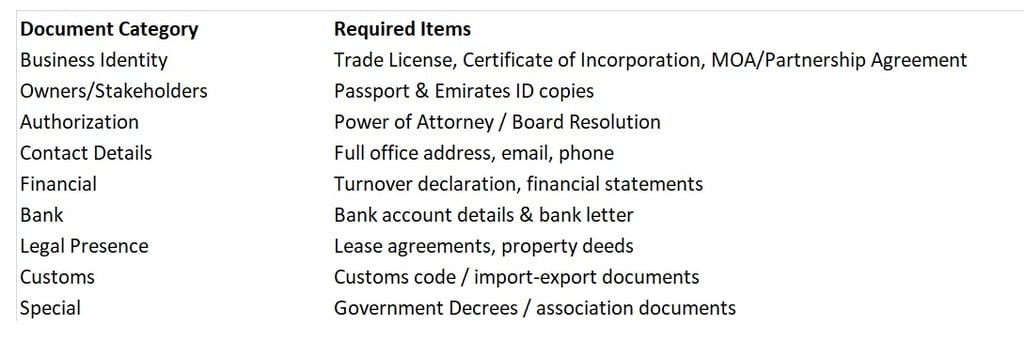
Document Checklist (Printable Version):
To make your life easier, here’s a concise checklist you can use before submission:
Common Issues & How to Avoid Them:
Issue 1: Missing or Expired Documents
Expired passports, Emirates IDs, or trade licenses are the top reasons for delayed approvals.
🔁 Make sure all documents are valid and current.
Issue 2: Incorrect Turnover Calculations
Misreporting taxable supply figures can lead to FTA penalties or even rejection.
📊 Cross-verify turnover figures with your accounting records.
Issue 3: Unsupported Financial Evidence
Submitting incomplete invoices, or financials can be problematic.
📗 Attach invoices, POs, and contracts directly related to turnover/expenses.
Processing Time & What to Expect After Submission:
Once all required documents are uploaded via the EmaraTax portal, the FTA typically reviews applications within 20 business days.
⌛ Note: Incomplete submissions may prompt additional queries and extend the review period.
Upon approval, you will receive a VAT Registration Certificate with your unique Tax Registration Number (TRN) — a critical identifier for VAT filings, invoices, and compliance obligations.
Penalties for Not Registering on Time:
Failure to register within the stipulated deadlines (e.g., within 30 days of exceeding the threshold) may attract penalties such as fines up to AED 10,000 or more.
➡ Prompt and proper documentation protects your business from avoidable regulatory costs.
Final Tips for Smooth VAT Registration:
✅ Start early — do not wait until the 30-day deadline approaches
✅ Double-check all financial figures before submission
✅ Consult a VAT professional if unsure about documentation
✅ Keep digital copies ready in PDF format with clear labels
✅ Organize supporting documents aligned with each field of the VAT form
Conclusion:
Successful VAT registration in the UAE hinges on one thing: complete, accurate, and well-organized documentation. With the FTA’s requirements updated for 2026 and beyond, businesses must stay informed and compliant.
The checklist above — from trade licenses to turnover declarations, financial evidence, and additional entity-specific documents — reflects the full spectrum of what the FTA expects from you. Submitting all documents correctly the first time will significantly reduce approval time and help your business remain compliant with UAE tax laws.
If you’re ready to register for VAT in the UAE but need assistance preparing your documents or submitting your application, visit uae-vatregistration.com for expert support tailored to your business needs.
© 2026 uae-vatregistration.com
